
Meet the Team


Primary Investigator
Eric J. Lang, PhD
Eric Lang is an Assistant Professor in the Nuclear Engineering Department at the University of New Mexico. He received his PhD in Nuclear, Plasma, and Radiological Engineering from the University of Illinois, Urbana-Champaign working with Prof. J.P. Allain in 2020. From 2020-2022, he held a postdoctoral appointment at Sandia National Laboratories working with Dr. Khalid Hattar. He has authored more than 35 peer-reviewed papers. Research interests include refractory metals, irradiation effects in materials, advanced materials synthesis, electron microscopy, and in-situ characterization.
PhD Students
Christian Arguello
Christian currently holds a graduate research position at Sandia National Laboratories where he works on fusion radiation transport using Monte Carlo methods. His dissertation will focus on the development of advanced fusion materials including tungsten borides for radiation shielding in high-energy neutron environments.


Masters Students
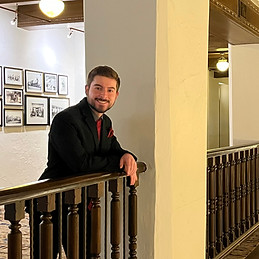
Nick Borrego
Nick is pursuing his M.S. in Nuclear Engineering with a research focus on chloride corrosion for dry cask storage. His work involves exposing 316L SS laser weldments to boiling MgCl2 to determine the time-to-failure and effects on mechanical properties. His research interests include alloy exposure to fluoride and chloride environments, advanced reactor concepts, and the effects that metallurgical work have on nuclear materials.
Facilities
Chloride Corrosion Experiments
SPACE Station

The Stress & Pitting Analysis in Chloride Environments (SPACE) Station is a highly corrosive environment based on ASTM standard practice G36 to evaluate the stress corrosion cracking on susceptible metals and alloys. The boiling MgCl2 solution provides accelerated tests for detecting the effects of composition, heat treatment, surface finish, microstructure, and stress effects on the corrosion of these materials. The solution is heated to 155°C in a 1-L, 4-neck round bottom flask using a heating mantle. A 500 mm Allihn condenser is connected to an industrial chiller to provide a steady reflux reaction. Multiple similar metal samples can be exposed simultaneously, and each experiment can run at constant temperature for up to seven days.
Mechanical Property Experiments
K&W Tensile Testing Module
The tensile testing machine of K&W is a versatile small-scale testing machine, which can be used inside a scanning electron microscope (SEM) but also outside underneath a light-microscope or atomic force microscope (AFM) to monitor the deformation behavior of samples during the experiments. It can be utilized for classical tensile tests but also bending or compression experiments. Depending on the shape and size of the specimens, different specimen clamps can be installed. In addition, it can be also tilted by 70° within the SEM that allows to perform electron back scatter diffraction (EBSD) measurements.

Mechanical Property Experiments
Bruker Pi 85 PicoIndenter

The Bruker PI 85 SEM PicoIndenter is a depth-sensing nanomechanical test instrument specifically designed to augment the imaging capabilities of scanning electron microscopes (SEM, FIB/SEM, PFIB). With this base nanoindentation tool, it is possible to perform quantitative in-situ nanomechanical testing while simultaneously imaging with the SEM. Featuring Bruker’s industry-leading capacitive transducer, PI 80 provides exceptional performance and superior stability at the nanoscale. Its compact, low-profile design makes the instrument ideally suited for small-chamber SEMs, as well as standalone Raman and optical microscopes, beamlines, and more.